22% Translated
22% Upvoted
2 Translations, 1 Upvotes, Last Activity 4 hours ago
1 Translations, 1 Upvotes, Last Activity 11 hours ago
1 Translations, 1 Upvotes, Last Activity 11 hours ago
1 Translations, 1 Upvotes, Last Activity 11 hours ago
1 Translations, 1 Upvotes, Last Activity 11 hours ago
1 Translations, 1 Upvotes, Last Activity 11 hours ago
1 Translations, 1 Upvotes, Last Activity 11 hours ago
1 Translations, 1 Upvotes, Last Activity 7 hours ago
1 Translations, 1 Upvotes, Last Activity 7 hours ago
1 Translations, 1 Upvotes, Last Activity 7 hours ago
1 Translations, 1 Upvotes, Last Activity 7 hours ago
1 Translations, 1 Upvotes, Last Activity 7 hours ago
1 Translations, 1 Upvotes, Last Activity 17 minutes ago
1 Translations, 1 Upvotes, Last Activity 22 minutes ago
1 Translations, 1 Upvotes, Last Activity 22 minutes ago
1 Translations, 1 Upvotes, Last Activity 22 minutes ago
1 Translations, 1 Upvotes, Last Activity 22 minutes ago
0 Translations, 0 Upvotes, Last Activity None
0 Translations, 0 Upvotes, Last Activity None
0 Translations, 0 Upvotes, Last Activity None
0 Translations, 0 Upvotes, Last Activity None
0 Translations, 0 Upvotes, Last Activity None
0 Translations, 0 Upvotes, Last Activity None
0 Translations, 0 Upvotes, Last Activity None
0 Translations, 0 Upvotes, Last Activity None
0 Translations, 0 Upvotes, Last Activity None
0 Translations, 0 Upvotes, Last Activity None
0 Translations, 0 Upvotes, Last Activity None
0 Translations, 0 Upvotes, Last Activity None
0 Translations, 0 Upvotes, Last Activity None
0 Translations, 0 Upvotes, Last Activity None
0 Translations, 0 Upvotes, Last Activity None
0 Translations, 0 Upvotes, Last Activity None
0 Translations, 0 Upvotes, Last Activity None
0 Translations, 0 Upvotes, Last Activity None
0 Translations, 0 Upvotes, Last Activity None
0 Translations, 0 Upvotes, Last Activity None
0 Translations, 0 Upvotes, Last Activity None
0 Translations, 0 Upvotes, Last Activity None
0 Translations, 0 Upvotes, Last Activity None
0 Translations, 0 Upvotes, Last Activity None
0 Translations, 0 Upvotes, Last Activity None
0 Translations, 0 Upvotes, Last Activity None
0 Translations, 0 Upvotes, Last Activity None
0 Translations, 0 Upvotes, Last Activity None
0 Translations, 0 Upvotes, Last Activity None
0 Translations, 0 Upvotes, Last Activity None
0 Translations, 0 Upvotes, Last Activity None
0 Translations, 0 Upvotes, Last Activity None
0 Translations, 0 Upvotes, Last Activity None
0 Translations, 0 Upvotes, Last Activity None
0 Translations, 0 Upvotes, Last Activity None
0 Translations, 0 Upvotes, Last Activity None
0 Translations, 0 Upvotes, Last Activity None
0 Translations, 0 Upvotes, Last Activity None
0 Translations, 0 Upvotes, Last Activity None
0 Translations, 0 Upvotes, Last Activity None
0 Translations, 0 Upvotes, Last Activity None
0 Translations, 0 Upvotes, Last Activity None
0 Translations, 0 Upvotes, Last Activity None
0 Translations, 0 Upvotes, Last Activity None
0 Translations, 0 Upvotes, Last Activity None
0 Translations, 0 Upvotes, Last Activity None
0 Translations, 0 Upvotes, Last Activity None
0 Translations, 0 Upvotes, Last Activity None
0 Translations, 0 Upvotes, Last Activity None
0 Translations, 0 Upvotes, Last Activity None
0 Translations, 0 Upvotes, Last Activity None
0 Translations, 0 Upvotes, Last Activity None
Credit Card Surfing
If you live in a coastal city in California, you’re familiar with the state icon: the surfer. You might spot them on the shore, wading waist-deep in the water, climbing onto their boards as a wave comes in, balancing, and riding it to the sand before heading out for the next one.
But there’s another kind of surfing that not everyone knows about, and I discovered it while managing the growing number of credit cards in my life. When I first moved to North America from the Netherlands in 1971, I lived in Canada and only had one credit card from the Bank of Montreal. I never felt the need for a higher credit limit. That changed after I moved to the U.S. in 1984. Suddenly, I was getting flyers almost every day, each one offering tempting credit card deals from banks and companies like VISA, Mastercard, American Express, and Discover.
These offers were hard to ignore. Each brochure listed the perks of a particular card—often no annual fee, a good interest rate, sometimes a special low rate for a set period, and the option to get cash at the bank when needed. Of course, getting cash usually meant paying a higher interest rate than just paying off your balance.
I often found these offers too tempting to pass up, especially when I needed cash for a purchase and didn’t have enough in my checking or savings account at Bank of America, where I’d been a customer since 1984.
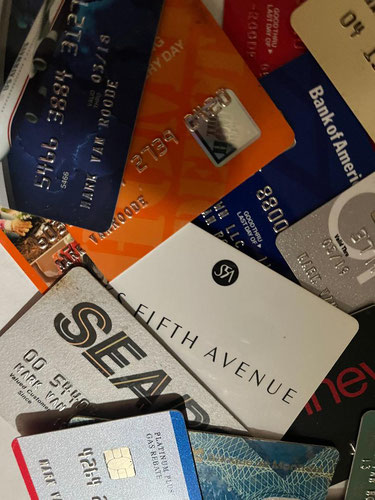
Eventually, I picked up credit cards from big department stores like Macy’s, Sears, Nordstrom, Saks Fifth Avenue, Bloomington, Target, and more. Usually, the incentive was a discount on something I was buying. While waiting at the counter for my jeans or shirt to be wrapped up, the sales associate would always ask, “Will that be cash or credit, sir? And do you have our store card? If not, and you're interested in obtaining one, we can sign you up right here. And you will get ten dollars off today’s purchase.”
Since I liked saving money, I often gave in and signed up. Five minutes later, the associate would finish the application, and soon another credit card would arrive in the mail, joining the growing stack in my wallet. Eventually, I stopped carrying them and just used my California driver’s license and social security number instead of the store card.
I also collected cards from other places—Ralphs, my main grocery store; Home Depot for hardware; ASME, my professional group; AAA, the auto club; and others.
At one point, I had more than 40 credit cards from different companies. Every time I used one, a bill would show up in the mail, politely reminding me to pay at least the minimum or the full balance by the due date. Even being a day late meant a hefty late fee, usually $20 or more, and some cards charged up to $39. Since I wasn’t always careful about mailing checks on time—and the mail could take a week—I started racking up late fees. To keep track, I made an Excel spreadsheet listing all my cards and their payment dates each month.
Thankfully, as banking moved online, managing payments became much easier. Now, when you pay, you know exactly when the transaction goes through, so it’s easier to avoid missing deadlines and those dreaded late fees.
As I collected more credit cards and some started to carry big balances—usually because I’d borrowed cash for a major purchase—I began getting a new kind of mail from banks. Sometimes these offers were for cards I already had, sometimes for new ones. They encouraged me to transfer balances from one card to another. At first, I was uneasy that banks knew about my debts with other companies. After making some phone calls, I realized my credit history was widely shared, not just with me and my lenders. At first, this bothered me, but I soon saw I could use it to my advantage.
These balance transfer offers often came with an interest-free period of six months or more. For example, if I moved $6,000 from one card to another with a transfer offer, I wouldn’t pay interest on that amount during the interest-free period. That meant saving several months’ worth of interest. If the rate was 10% and the offer lasted six months, I’d save $300 on a $6,000 balance—money I could use elsewhere.
There was another kind of offer that was even more tempting. My own bank, BoA, once let me borrow up to $20,000 against one of my credit cards. I had six months to pay it back before it started collecting interest at a high rate, like a cash advance. But for those six months, I had $20,000 in free cash. Near the end of that period, I could move the balance to another card and get another six months interest-free. I kept repeating this process with my many cards. Of course, I’d have to pay it all back eventually, but I hoped I’d be in a better financial position by then. I called this strategy ‘credit card surfing’.
A great chance to use ‘credit card surfing’ came when I bought a new condo in Mission Valley, San Diego, in 1998. I’d lived in the area since 1990 and had just sold my one-bedroom place to buy a larger three-bedroom condo about a mile away for $170,000, which was a good deal at the time. I got a mortgage from Downey Savings & Loan Ass. with a 10% down payment and a $153,000 loan at a fixed 6.625% interest rate, to be paid over 30 years. That meant monthly payments of $980, plus mortgage insurance until my loan-to-value ratio dropped to 75%, which happened in 2000. After that, I just paid $980 each month. If I kept this up, I’d own the place outright in 2028, at age 84, after paying a total of $352,800—more than double the original price.
With easy access to cash from credit cards, I started thinking: what if I could pay off my mortgage much faster than 30 years? That would save a lot in interest and let me own my home sooner. By the end of 2002, my regular payments had brought the mortgage down to $134,000. After some research, I found a new mortgage with Downey Savings & Loan Ass. at 4.375% interest, which lowered my monthly payment to $669 from $980. The lower rate was partly because mortgage rates had dropped and partly because this was an Adjustable-Rate Mortgage (ARM), which would change after three years, in December 2005. Since I planned to pay off the mortgage by then, the ARM made sense.
Both my old and new mortgages let me pay them off faster by making bigger payments, with no penalty. I used those tempting credit card offers to get easy cash and speed up my payments. In January 2005, I made my last mortgage payment. Over seven years, I’d paid about $184,000 on two mortgages. If I’d stuck to the original plan, I would have paid $352,800, so I saved $168,800. Best of all, I was only 60 when I became mortgage-free!
To get those savings, I ended up with over $100,000 in extra credit card debt from credit card surfing. To pay it off, I used a two-part plan. First, I avoided interest by moving balances from one card to another before the interest-free period ended, giving me another six months each time. I did this with nine different cards. Second, I started paying down the debt quickly, focusing on the biggest balances. By the end of 2006, I’d cleared all the mortgage-related debt. After that, any remaining debt was just from regular purchases, which I paid off each month to avoid interest.
As I paid off my debts, I started closing credit cards I didn’t use anymore. I called the banks to cancel them, and soon I had just a few cards for everyday use. I also noticed changes in the mail from credit card companies. The offers and mailings became less frequent, and those tempting balance transfer and cash advance deals stopped coming. I guessed that the banks saw my lower balances and decided I wasn’t as profitable. It also seemed like the credit card industry had changed, probably because of the 2008 market crash.
Regardless, I was not unhappy with the reduction in finance-related mail and relished the idea that the credit card companies had helped me own my home free and clear without a long-term mortgage commitment.
Quite a few years have passed. I pay off the balance on my credit card religiously every month, well before the due date. I’ve left the excitement of credit card surfing behind.
MvR, March 6, 2022. ✍️