100% Translated
63% Upvoted
1 Translations, 1 Upvotes, Last Activity 10 months ago
1 Translations, 1 Upvotes, Last Activity 10 months ago
1 Translations, 1 Upvotes, Last Activity 10 months ago
1 Translations, 1 Upvotes, Last Activity 10 months ago
1 Translations, 1 Upvotes, Last Activity 10 months ago
1 Translations, 1 Upvotes, Last Activity 10 months ago
1 Translations, 1 Upvotes, Last Activity 10 months ago
1 Translations, 1 Upvotes, Last Activity 10 months ago
1 Translations, 1 Upvotes, Last Activity 10 months ago
2 Translations, 1 Upvotes, Last Activity 9 months, 4 weeks ago
1 Translations, 1 Upvotes, Last Activity 9 months, 4 weeks ago
1 Translations, 1 Upvotes, Last Activity 9 months, 4 weeks ago
2 Translations, 2 Upvotes, Last Activity 9 months, 4 weeks ago
1 Translations, 1 Upvotes, Last Activity 9 months, 4 weeks ago
1 Translations, 1 Upvotes, Last Activity 9 months, 4 weeks ago
1 Translations, 1 Upvotes, Last Activity 9 months, 4 weeks ago
1 Translations, 1 Upvotes, Last Activity 9 months, 4 weeks ago
1 Translations, 1 Upvotes, Last Activity 9 months, 4 weeks ago
1 Translations, 1 Upvotes, Last Activity 9 months, 4 weeks ago
1 Translations, 1 Upvotes, Last Activity 9 months, 4 weeks ago
1 Translations, 1 Upvotes, Last Activity 9 months, 4 weeks ago
1 Translations, 0 Upvotes, Last Activity 9 months, 4 weeks ago
1 Translations, 0 Upvotes, Last Activity 9 months, 4 weeks ago
1 Translations, 0 Upvotes, Last Activity 9 months, 4 weeks ago
1 Translations, 0 Upvotes, Last Activity 9 months, 4 weeks ago
1 Translations, 0 Upvotes, Last Activity 9 months, 4 weeks ago
1 Translations, 0 Upvotes, Last Activity 9 months, 3 weeks ago
1 Translations, 0 Upvotes, Last Activity 9 months, 3 weeks ago
1 Translations, 0 Upvotes, Last Activity 9 months, 3 weeks ago
1 Translations, 0 Upvotes, Last Activity 9 months, 3 weeks ago
1 Translations, 0 Upvotes, Last Activity 9 months, 3 weeks ago
1 Translations, 0 Upvotes, Last Activity 9 months, 3 weeks ago
1 Translations, 0 Upvotes, Last Activity 9 months, 3 weeks ago
Iran wil Teheran nu echt verhuizen, als laatste redmiddel in ‘waterbankroet’.
De Iraanse hoofdstad Teheran is zo zwaar getroffen door droogte dat er volgens president Masoud Pezeshkian ‘geen andere keuze’ meer is dan de stad te verhuizen naar de zuidkust van Iran. Wat Pezeshkian verzwijgt: Iran veroorzaakt zijn watercrisis zelf.
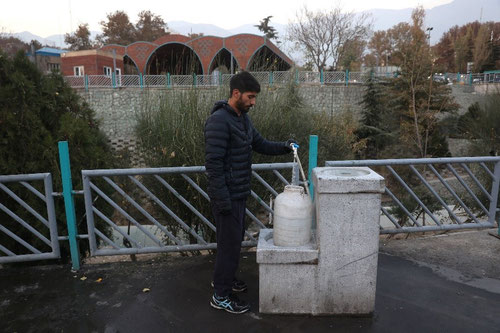
Foto 1 - Een man vult een watertank in de Iraanse hoofdstad Teheran. Bron Reuters.
Door Maarten Keulemans, wetenschapsredacteur, De Volkskrant, 21 november 2025.
De meest verwoestende aanslag op de toekomst van Iran zijn niet de sancties, resoluties of luchtaanvallen. Nee, ‘het is de lucht die niet langer regent, het zijn de rivieren die niet meer stromen, en de waterreservoirs die zijn droog gepompt. Het is de droogte.’
Dat schrijft Kaveh Madani, een Iraanse milieuwetenschapper in dienst van de VN, in zakenblad Forbes, nu de droogte in Iran extreme vormen aanneemt. Hoewel het bijna winter is, is er nog altijd geen regen in Teheran gevallen. En dus rakelt president Pezeshkian het oude plan weer op, kort na 2000 geïntroduceerd door toenmalig president Mahmoud Ahmadinejad: Teheran moet hier weg, naar Makran aan de zuidkust, aan de Golf van Oman.
Daarachter zitten vele redenen. Er is acute nood: Teheran is met zijn 14 miljoen inwoners overbevolkt en zwaar vervuild, de droogte zorgt voor stroomuitval, en er dreigen voortdurend aardbevingen.
Er is de economie: Iran wil aanhaken bij de bloeiende handelsroutes van de Perzische Golf en de Golf van Oman richting Azië, en Teheran wil zijn grondstoffen niet langer eerst meer dan duizend kilometer over land hoeven te transporteren. En er is de politiek: het volk mort, het regime vreest waterrellen.
In dat krachtenspel is de droogte aanjager. Voor het zesde jaar op rij wil de regen niet komen. Zónder klimaatverandering zou je zo’n periode ook twee tot drie keer per eeuw mogen verwachten, maar in het huidige klimaat is de droogte volstrekt normaal, becijferen klimaatwetenschappers in een vrijdag verschenen analyse. De waterreservoirs rond Teheran hebben nog maar 5 procent van hun voorraad over, en in de stad is er nauwelijks waterdruk en stroom.
Onomkeerbare crisis.
Maar het probleem zit dieper. In 2021 waarschuwden Canadees-Iraanse onderzoekers ervoor in vakblad Scientific Reports dat Iran zó verkeerd omgaat met water, dat het wachten is op een diepe, onomkeerbare crisis. De reactie van het regime was veelzeggend: vlug haalde Iran de openbare overheidscijfers waarop de wetenschappers zich baseerden offline.
Volgens het drinkwaterbedrijf van Teheran is het waterpeil in zestig jaar niet zo laag geweest. Bron Reuters.
‘Decennialang zijn Iraanse beleidsmakers met water omgegaan alsof het een onuitputtelijke bron is’, signaleert waterexpert Madani. Zo moedigde het regime, woestijn of niet, de teelt van waterintensieve gewassen zoals rijst en tomaten aan met grootschalige irrigatie, om de afhankelijkheid van het buitenland te verkleinen. Intussen opende men links en rechts dammen, vooral als prestigeproject, en liet men de lekkende waterleidingen van onder meer Teheran verpieteren.
‘Ik noem dit geen crisis. Dit is een toestand van falen. Een waterbankroet’, zei Madani eerder deze week tegen de Amerikaanse nieuwszender NBC. ‘Het is een no-brainer dat dit zou gebeuren’, reageert Ali Nazemi, hoofdauteur van het Canadese onderzoek dat de crisis voorspelde. ‘Het narratief dat klimaatverandering verantwoordelijk zou zijn, is om eerlijk te zijn niet erg accuraat’, stelt de Amerikaans-Iraanse hoogleraar watertechniek Amir AghaKouchak.
Oorlogsstand.
Het zou helpen, denkt Madani, als Iran omschakelde van wat hij noemt een ‘economie van verzet naar een economie van weerbaarheid’. Daarmee bedoelt hij: uiteindelijk komt het door de permanent paranoïde oorlogsstand waarin Iran verkeert dat het land teveel water gebruikt. Terwijl de regering juist weerbaarheid zou moeten tonen tegen het feit dat het toch al schaarse water vanwege het opwarmende klimaat nog schaarser wordt.
De vraag is alleen of het voor die omschakeling niet al te laat is. ‘Toen we eerder zeiden dat we de hoofdstad moeten verplaatsen, hadden we niet genoeg budget’, zei president Pezeshkian donderdag, volgens het Saoedische nieuwskanaal Iran International. ‘De werkelijkheid is dat we onderhand geen keuze meer hebben. Het is een verplichting.’
https://www.volkskrant.nl/wetenschap/iran-wil-teheran-nu-echt-verhuizen-als-laatste-redmiddel-in-waterbankroet~bb5f772a/