100% Translated
0% Upvoted
1 Translations, 0 Upvotes, Last Activity 4 months, 3 weeks ago
1 Translations, 0 Upvotes, Last Activity 4 months, 3 weeks ago
1 Translations, 0 Upvotes, Last Activity 4 months, 3 weeks ago
1 Translations, 0 Upvotes, Last Activity 4 months, 3 weeks ago
1 Translations, 0 Upvotes, Last Activity 4 months, 3 weeks ago
1 Translations, 0 Upvotes, Last Activity 4 months, 3 weeks ago
1 Translations, 0 Upvotes, Last Activity 4 months, 3 weeks ago
1 Translations, 0 Upvotes, Last Activity 4 months, 3 weeks ago
1 Translations, 0 Upvotes, Last Activity 4 months, 3 weeks ago
1 Translations, 0 Upvotes, Last Activity 4 months, 3 weeks ago
1 Translations, 0 Upvotes, Last Activity 4 months, 3 weeks ago
1 Translations, 0 Upvotes, Last Activity 4 months, 3 weeks ago
1 Translations, 0 Upvotes, Last Activity 4 months, 3 weeks ago
1 Translations, 0 Upvotes, Last Activity 4 months, 3 weeks ago
1 Translations, 0 Upvotes, Last Activity 4 months, 3 weeks ago
1 Translations, 0 Upvotes, Last Activity 4 months, 3 weeks ago
1 Translations, 0 Upvotes, Last Activity 4 months, 3 weeks ago
1 Translations, 0 Upvotes, Last Activity 4 months, 3 weeks ago
1 Translations, 0 Upvotes, Last Activity 4 months, 3 weeks ago
1 Translations, 0 Upvotes, Last Activity 4 months, 3 weeks ago
1 Translations, 0 Upvotes, Last Activity 4 months, 3 weeks ago
1 Translations, 0 Upvotes, Last Activity 4 months, 3 weeks ago
1 Translations, 0 Upvotes, Last Activity 4 months, 3 weeks ago
1 Translations, 0 Upvotes, Last Activity 4 months, 3 weeks ago
1 Translations, 0 Upvotes, Last Activity 4 months, 3 weeks ago
1 Translations, 0 Upvotes, Last Activity 4 months, 3 weeks ago
1 Translations, 0 Upvotes, Last Activity 4 months, 3 weeks ago
1 Translations, 0 Upvotes, Last Activity 4 months, 3 weeks ago
1 Translations, 0 Upvotes, Last Activity 4 months, 3 weeks ago
1 Translations, 0 Upvotes, Last Activity 4 months, 3 weeks ago
1 Translations, 0 Upvotes, Last Activity 4 months, 3 weeks ago
1 Translations, 0 Upvotes, Last Activity 4 months, 3 weeks ago
1 Translations, 0 Upvotes, Last Activity 4 months, 3 weeks ago
1 Translations, 0 Upvotes, Last Activity 4 months, 3 weeks ago
1 Translations, 0 Upvotes, Last Activity 4 months, 3 weeks ago
1 Translations, 0 Upvotes, Last Activity 4 months, 3 weeks ago
1 Translations, 0 Upvotes, Last Activity 4 months, 3 weeks ago
1 Translations, 0 Upvotes, Last Activity 4 months, 3 weeks ago
1 Translations, 0 Upvotes, Last Activity 4 months, 3 weeks ago
1 Translations, 0 Upvotes, Last Activity 4 months, 3 weeks ago
1 Translations, 0 Upvotes, Last Activity 4 months, 3 weeks ago
1 Translations, 0 Upvotes, Last Activity 4 months, 3 weeks ago
1 Translations, 0 Upvotes, Last Activity 4 months, 3 weeks ago
1 Translations, 0 Upvotes, Last Activity 4 months, 3 weeks ago
1 Translations, 0 Upvotes, Last Activity 4 months, 3 weeks ago
1 Translations, 0 Upvotes, Last Activity 4 months, 3 weeks ago
1 Translations, 0 Upvotes, Last Activity 4 months, 3 weeks ago
1 Translations, 0 Upvotes, Last Activity 4 months, 3 weeks ago
1 Translations, 0 Upvotes, Last Activity 4 months, 3 weeks ago
1 Translations, 0 Upvotes, Last Activity 4 months, 3 weeks ago
1 Translations, 0 Upvotes, Last Activity 4 months, 3 weeks ago
1 Translations, 0 Upvotes, Last Activity 4 months, 3 weeks ago
1 Translations, 0 Upvotes, Last Activity 4 months, 3 weeks ago
1 Translations, 0 Upvotes, Last Activity 4 months, 2 weeks ago
1 Translations, 0 Upvotes, Last Activity 4 months, 2 weeks ago
1 Translations, 0 Upvotes, Last Activity 4 months, 2 weeks ago
1 Translations, 0 Upvotes, Last Activity 4 months, 2 weeks ago
1 Translations, 0 Upvotes, Last Activity 4 months, 2 weeks ago
1 Translations, 0 Upvotes, Last Activity 4 months, 2 weeks ago
1 Translations, 0 Upvotes, Last Activity 4 months, 2 weeks ago
1 Translations, 0 Upvotes, Last Activity 4 months, 2 weeks ago
1 Translations, 0 Upvotes, Last Activity 4 months, 2 weeks ago
1 Translations, 0 Upvotes, Last Activity 4 months, 2 weeks ago
1 Translations, 0 Upvotes, Last Activity 4 months, 2 weeks ago
1 Translations, 0 Upvotes, Last Activity 4 months, 2 weeks ago
1 Translations, 0 Upvotes, Last Activity 4 months, 2 weeks ago
1 Translations, 0 Upvotes, Last Activity 4 months, 2 weeks ago
1 Translations, 0 Upvotes, Last Activity 4 months, 2 weeks ago
1 Translations, 0 Upvotes, Last Activity 4 months, 2 weeks ago
1 Translations, 0 Upvotes, Last Activity 4 months, 2 weeks ago
1 Translations, 0 Upvotes, Last Activity 4 months, 2 weeks ago
1 Translations, 0 Upvotes, Last Activity 4 months, 2 weeks ago
1 Translations, 0 Upvotes, Last Activity 4 months, 2 weeks ago
1 Translations, 0 Upvotes, Last Activity 4 months, 2 weeks ago
1 Translations, 0 Upvotes, Last Activity 4 months, 2 weeks ago
1 Translations, 0 Upvotes, Last Activity 4 months, 2 weeks ago
1 Translations, 0 Upvotes, Last Activity 4 months, 2 weeks ago
1 Translations, 0 Upvotes, Last Activity 4 months, 2 weeks ago
1 Translations, 0 Upvotes, Last Activity 4 months, 2 weeks ago
1 Translations, 0 Upvotes, Last Activity 4 months, 2 weeks ago
1 Translations, 0 Upvotes, Last Activity 4 months, 2 weeks ago
1 Translations, 0 Upvotes, Last Activity 4 months, 2 weeks ago
Thioester-Mediated RNA Aminoacylation and Peptidyl-RNA Synthesis in Water.
This article is based on an AI-generated summary of a recent article in Nature: https://www.nature.com/articles/s41586-025-09388-y .
Singh, J., Thoma, B., Whitaker, D., Webley, M. S., Yao, Y. & Powner, M. W. “Thioester-mediated RNA aminoacylation and peptidyl-RNA synthesis in water.” Nature 644, 933–944 (2025). DOI: 10.1038/s41586-025-09388-y. Published 27 August 2025.
The paper is Open Access (Creative Commons Attribution 4.0).
The Problem: How Were Amino Acids First Attached to RNA?.
It addresses one of the central puzzles in origin-of-life chemistry: how the first link between RNA and amino acids could have formed before modern enzymes existed. In present-day biology, proteins are made through ribosomal peptide synthesis. This process depends on transfer RNAs, or tRNAs, which carry amino acids to the ribosome. Before an amino acid can be used to build a protein, it must first be attached to the end of a tRNA. This attachment is called aminoacylation. Today, aminoacylation is carried out by highly specific enzymes called aminoacyl-tRNA synthetases. The paradox is that these enzymes are themselves proteins, and proteins require the ribosomal system to be made. Thus, a key question is how RNA could first have been aminoacylated before the evolution of the protein enzymes that now perform the task.
The authors focus on a chemically realistic version of this problem. For a prebiotic pathway to be plausible, it should work in water, at roughly neutral pH, and without sophisticated enzymes. It should also be selective: amino acids should attach to RNA rather than simply reacting randomly with each other to form uncontrolled peptides.
Previous attempts to solve this problem used highly activated amino-acid derivatives, such as aminoacyl phosphates, aminoacyl imidazoles, or N-carboxyanhydrides. These can react, but they are often unstable in water and tend to produce unwanted side reactions, especially random peptide formation. The authors therefore looked for a milder form of chemical activation that could favor RNA aminoacylation over uncontrolled peptide synthesis.
The Thioester Solution.
Their proposed solution is based on thioesters, especially aminoacyl-thiols. Thioesters are chemically important in modern metabolism and are associated with ancient biochemical ideas such as the “thioester world.” In living cells, coenzyme A and related thiol-containing cofactors are widely used to transfer acyl groups. The authors reasoned that aminoacyl-thiols might have served as early chemical intermediates capable of linking amino acids to RNA before the appearance of modern protein enzymes.
A major result of the paper is that aminoacyl-thiols can selectively aminoacylate RNA-like molecules in water. In simpler terms, these compounds can attach amino acids to the ribose sugar part of RNA under mild aqueous conditions. Importantly, they do this while largely suppressing the direct formation of peptides from amino acids. This is significant because uncontrolled peptide formation would produce chemical “noise,” whereas biological protein synthesis requires amino acids to be held and organized through RNA before peptide bonds are made.
The authors first examined the behavior of alanine thioester in water. They found that it was relatively stable and did not readily polymerize into peptides. At neutral pH, peptide formation was very inefficient; hydrolysis was the main competing process. This finding was somewhat surprising, because thioesters are often thought of as activated compounds that might easily react with amines. Here, however, the aminoacyl-thiol reacted poorly with amine nucleophiles but could react productively with ribonucleosides. That difference is central to the paper’s argument: thioester activation is mild enough to avoid uncontrolled peptide synthesis but still capable of transferring an amino acid to RNA.
The authors then tested ribonucleosides, the building blocks of RNA. They found that aminoacyl-thiols could aminoacylate the 2′,3′-diol region of ribonucleosides. This is the same general chemical region involved in modern tRNA aminoacylation. The reaction worked best around mildly acidic to neutral pH, especially near pH 6.5, where the products were more stable and the desired selectivity was better. The reaction occurred despite the overwhelming presence of water and despite the presence of other potential nucleophiles. This shows a useful chemical preference for RNA-like diols over many competing groups.
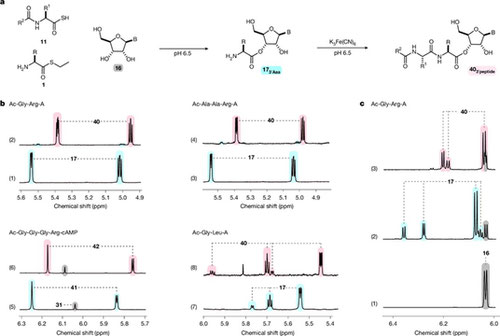
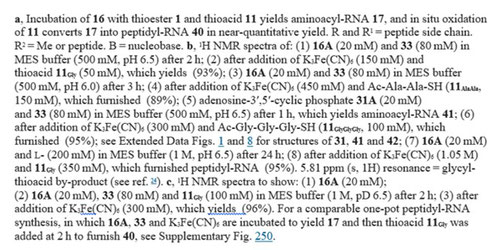
Figure 4.6 of the paper illustrates the primary chemical pathway and follows the reaction by means of spectroscopic techniques – Figure and caption attributed to the cited article: Singh et al.
The selectivity was not unlimited, however. Single-stranded RNA contains many internal 2′-hydroxyl groups, so unwanted internal aminoacylation can occur. The authors found that duplex formation solves much of this problem. When RNA forms a duplex, internal hydroxyl groups become less accessible, while the terminal 2′,3′-diol remains available. As a result, double-stranded or duplex-like RNA structures can direct aminoacylation toward the terminal position. This is important because modern tRNA aminoacylation occurs at the end of the RNA molecule. The result suggests that RNA’s ability to form structured duplexes may have helped early chemistry become more selective even before enzymes evolved.
The paper also reports broad amino-acid compatibility. The authors tested aminoacyl-thiols derived from many proteinogenic amino acids, including alanine, arginine, aspartate, glutamate, glutamine, glycine, histidine, leucine, lysine, methionine, phenylalanine, proline, serine and valine. The reaction tolerated many different side chains. This breadth matters because a plausible prebiotic route should not work only for one special amino acid. One especially interesting observation was that arginine showed enhanced aminoacylation, apparently through side-chain-assisted catalysis. Because arginine-rich peptides and RNA interactions are important in biology, this result may have implications for early RNA–peptide coevolution.
Another important part of the study concerns how aminoacyl-thiols themselves might have formed. The authors show that several plausible activated amino-acid precursors can react with thiols in water to give aminoacyl-thiols. These include prebiotic nitriles, N-carboxyanhydrides, amino acid anhydrides, and biological aminoacyl-adenylates. They also tested thiols related to biological cofactors, including coenzyme A and coenzyme M. This strengthens the argument that aminoacyl-thiols are not merely convenient laboratory reagents but could plausibly connect prebiotic chemistry with modern biochemical logic.
Toward the First RNA-Guided Peptides.
The final stage of the paper addresses peptide formation. If thioesters are useful because they favor RNA aminoacylation and suppress random peptide formation, how can peptides eventually be made? The authors answer this by distinguishing thioester activation from thioacid activation. They show that switching from thioester to thioacid chemistry reverses the selectivity. Thioesters favor reaction with RNA diols; activated thioacids favor reaction with amines, enabling peptide-bond formation. Thus, two chemically related but distinct activation modes can control two different stages: first, amino acid loading onto RNA; second, peptide formation from aminoacyl-RNA.
This distinction allowed the authors to demonstrate a two-step, one-pot formation of peptidyl-RNA in water. First, an aminoacyl-thiol attaches an amino acid to a ribonucleoside or RNA-like substrate. Then, a thioacid-mediated reaction forms a peptide bond, yielding peptidyl-RNA. The authors report high to near-quantitative yields in several examples, including reactions producing glycyl-, alanyl-, and leucyl-containing peptidyl-RNA products. The reactions occurred under mild aqueous conditions, without evolved enzymes and without purification of the intermediate aminoacyl-RNA.
The significance of the study is that it offers a chemically coherent pathway from amino-acid activation to RNA aminoacylation and then to peptidyl-RNA synthesis. It does not claim to reproduce the full origin of translation or the genetic code. Rather, it addresses a missing chemical step: how amino acids might first have become selectively attached to RNA in water. By showing that thiol chemistry can accomplish this selectively, the authors provide a possible bridge between prebiotic chemistry and modern biology.
The broader implication is that thiol cofactors may have played a central role before the evolution of modern protein enzymes. In contemporary life, coenzyme A and related thiols are fundamental to metabolism. This paper suggests that such chemistry may also have helped establish the earliest RNA–amino acid connections. If so, the relationship between RNA and peptides may not have begun with fully developed ribosomes or synthetase enzymes, but with simpler chemical systems in which thiols controlled whether amino acids were transferred to RNA or joined into peptides.
In conclusion, Singh and colleagues present a persuasive experimental case that aminoacyl-thiols can selectively aminoacylate RNA in water and that related thioacid chemistry can then produce peptidyl-RNA. The work is important because it separates two steps that are often chemically entangled: loading amino acids onto RNA and forming peptide bonds. By controlling these steps through thioester versus thioacid activation, the authors provide a plausible chemical route toward early RNA-guided peptide synthesis. The study therefore contributes to origin-of-life research by showing how RNA, amino acids, and ancient thiol-based metabolism could have become linked before the emergence of modern enzymatic translation.
Summary prepared with the assistance of ChatGPT.
MvR, June 3, 2026. ✍️