0% Translated
0% Upvoted
0 Translations, 0 Upvotes, Last Activity None
0 Translations, 0 Upvotes, Last Activity None
0 Translations, 0 Upvotes, Last Activity None
0 Translations, 0 Upvotes, Last Activity None
0 Translations, 0 Upvotes, Last Activity None
0 Translations, 0 Upvotes, Last Activity None
0 Translations, 0 Upvotes, Last Activity None
0 Translations, 0 Upvotes, Last Activity None
0 Translations, 0 Upvotes, Last Activity None
0 Translations, 0 Upvotes, Last Activity None
0 Translations, 0 Upvotes, Last Activity None
0 Translations, 0 Upvotes, Last Activity None
0 Translations, 0 Upvotes, Last Activity None
0 Translations, 0 Upvotes, Last Activity None
0 Translations, 0 Upvotes, Last Activity None
0 Translations, 0 Upvotes, Last Activity None
0 Translations, 0 Upvotes, Last Activity None
0 Translations, 0 Upvotes, Last Activity None
0 Translations, 0 Upvotes, Last Activity None
0 Translations, 0 Upvotes, Last Activity None
0 Translations, 0 Upvotes, Last Activity None
0 Translations, 0 Upvotes, Last Activity None
0 Translations, 0 Upvotes, Last Activity None
0 Translations, 0 Upvotes, Last Activity None
0 Translations, 0 Upvotes, Last Activity None
0 Translations, 0 Upvotes, Last Activity None
0 Translations, 0 Upvotes, Last Activity None
0 Translations, 0 Upvotes, Last Activity None
0 Translations, 0 Upvotes, Last Activity None
0 Translations, 0 Upvotes, Last Activity None
0 Translations, 0 Upvotes, Last Activity None
0 Translations, 0 Upvotes, Last Activity None
0 Translations, 0 Upvotes, Last Activity None
0 Translations, 0 Upvotes, Last Activity None
0 Translations, 0 Upvotes, Last Activity None
0 Translations, 0 Upvotes, Last Activity None
The Evolution of California License Plates II.
🔵 The Blue Plate Transition (1970–1980)
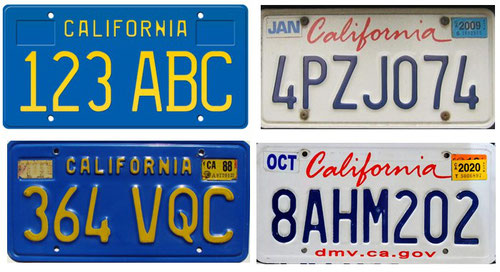
By 1970, California once again refreshed its plates, switching to a blue background with yellow lettering, while retaining the same ABC 123 format.
Photo - Blue Plates with Yellow lettering.
This change was largely aesthetic, but it coincided with a dramatic increase in vehicle registrations. California was becoming the automotive capital of the United States, and the number of registered vehicles surged into the millions.
Despite the unchanged format, the system was nearing its limits. The combination of three letters and three digits, while once sufficient, was no longer adequate for the scale of California’s growth. By the end of the decade, a more radical solution was required.
⚪ The Modern System (1980–Present)
In 1980, California introduced the format still in use today: 1ABC234.
Photo - White plates with blue lettering.
This new system dramatically expanded the number of available combinations by adding an additional digit and restructuring the sequence. The design also shifted to the now-familiar white background, with blue alphanumeric characters and the red cursive “California” at the top.
What makes this system particularly interesting is its sequential progression. Each leading digit represents a broad era of issuance:
• 1-series → early 1980s.
• 2–4 series → late 1980s through 1990s.
• 5–6 series → 2000s.
• 7–8 series → 2010s–2020s.
• 9-series → current final stretch.
My own license plate, beginning with 8, places it squarely in the later phase of this decades-long system—effectively a timestamp of when the vehicle first entered circulation.
This format has proven remarkably durable, lasting more than four decades. However, as California now has over 30 million registered vehicles, even this expanded system is approaching its limits.
🔮 The Road Ahead
At some point—likely within the next decade—California will reach the end of its current sequence: 9ZZZ999.
Just this morning, I spotted a car with the combination 9XXX594. I’m on the lookout for a car with 9Y….. I’ll expect to see one before summer.
When 9ZZZ999 happens, the state will need to adopt a new format. Although no official design has yet been announced, the most likely successor is: ABC1234.
This would once again expand capacity while maintaining clarity and simplicity.
🎨 Parallel Developments: Specialty and Legacy Plates
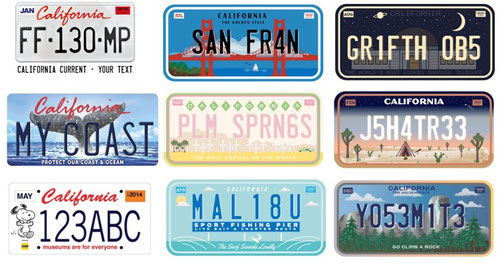
While the main numbering system evolved cautiously, California introduced a wide array of specialty and optional plates alongside it.
These include:
• Environmental and conservation-themed plates.
• University and organizational plates.
• Personalized (“vanity”) plates.
• Legacy plates, including the revival of the black-and-yellow 1960s design.
• Disabled Persons (DP) plates.
• Military & Veteran Plates.
These plates operate parallel to the main numbering system, offering aesthetic and personal choice without altering the underlying allocation of standard plate numbers.
The reintroduction of the black plate in modern form is particularly notable: it reflects not necessity, but nostalgia—a recognition of the enduring cultural appeal of earlier designs.
To drive a car with California DMV license plates doesn’t come cheap. For most cars the annual fee is in the $100-$500 range. Newer cars come with higher fees. Fees decline as the car ages. The fee itself is a composite made up of base registration, CHP (California Highway Patrol), State/Local fees, VLF (Vehicle Licence Fee), the big one, equivalent to 0.65% of the car’s value, and some additional minor fees.
If you wish to have a personalized(vanity) plate, there is an initial outlay of about $100 and an annual renewal fee of $80. Hmm, I’m thinking about TRANSL8. A good chance, it’ll still be available, i.e. not already taken by someone else. Or maybe TRNSLAT? You’ve got to be creative. I checked with the DMV, TRANSL8 is not available, but TRNSLAT is.
You have a choice of designs. I like yellow lettering on a black background. Classy, and certainly personalized. And unlike a standard license plate, you can carry the vanity plate forward to another vehicle.
Disabled Persons (DP) plates are issued to handicapped people. They can be a special plate with the designation DP or a placard that can be suspended from the rearview mirror and which is transferrable between cars. The plate guarantees special parking privileges.
Military & Veteran plates can be issued to people who have served with distinction or underwent extreme hardships while serving in the military, such as recipients of the Purple Heart, disabled veterans, Pearl Harbor Survivors, former prisoners of war (POWs).
Organizational/Group Plates are less common, but include university/college plates (for select programs), and certain approved nonprofit or organizational plates.
Temporary/Transitional Plates are issued at purchase of a vehicle, to be replaced by permanent plates.
🧠 Conclusion.
California’s license plates tell a quiet but fascinating story of growth. From the modest numeric systems of the 1950s to the vast combinatorial structure of today, each change reflects a practical response to one underlying reality: more people, more cars, more movement.
My observation of a “9XXX594” plate captures a moment near the end of a long chapter—one that began in 1980 and is now approaching its natural conclusion. In that sense, every license plate on the road is not just an identifier, but a small marker of California’s continuing evolution.
MvR, April 8, 2026. ChatGPT contributed. ✍️