0% Translated
0% Upvoted
0 Translations, 0 Upvotes, Last Activity None
0 Translations, 0 Upvotes, Last Activity None
0 Translations, 0 Upvotes, Last Activity None
0 Translations, 0 Upvotes, Last Activity None
0 Translations, 0 Upvotes, Last Activity None
0 Translations, 0 Upvotes, Last Activity None
0 Translations, 0 Upvotes, Last Activity None
0 Translations, 0 Upvotes, Last Activity None
0 Translations, 0 Upvotes, Last Activity None
0 Translations, 0 Upvotes, Last Activity None
0 Translations, 0 Upvotes, Last Activity None
0 Translations, 0 Upvotes, Last Activity None
0 Translations, 0 Upvotes, Last Activity None
0 Translations, 0 Upvotes, Last Activity None
The Evolution of California License Plates I.
An overview of design, numbering, and growth.
🟡 The Postwar Standardization Era (1956–1962)
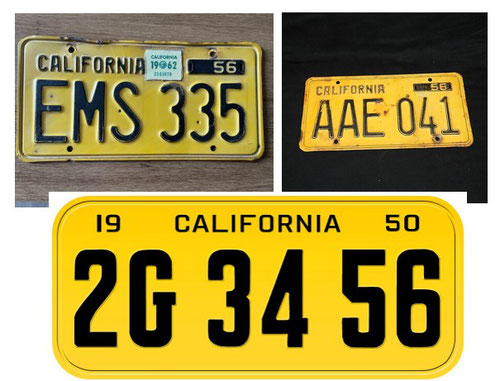
Photo - Yellow plates with black lettering.
In 1956, a quiet but important change took place across the United States: license plates were standardized in size, mounting holes, and general proportions. California adopted this national standard, ushering in a more uniform appearance that persists to this day.
During this period, California plates typically featured yellow backgrounds with black lettering, and the numbering system leaned heavily on numeric combinations with limited letters. The system worked well enough for a state still emerging from its postwar expansion, but the seeds of a future problem were already visible: California’s population—and its car ownership—were growing at a remarkable pace.
The numbering schemes of the time were not designed for tens of millions of vehicles. By the early 1960s, it was clear that a more flexible system would soon be required.
⚫ The Black Plate Era (1963–1969).
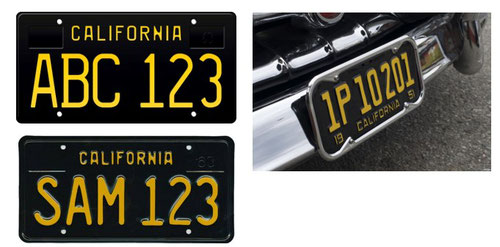
In 1963, California introduced what would become one of its most iconic designs: the black plate with yellow lettering, using a simple and elegant format: ABC 123.
Photo - Black license plates with yellow lettering.
This format provided a much larger pool of combinations and was visually striking—high contrast, easy to read, and aesthetically pleasing. The plates quickly became associated with the golden age of California car culture: freeways expanding, suburbs spreading, and automobiles becoming central to daily life.
Many of these plates remain in circulation today, especially on classic cars that have retained continuous registration. Among enthusiasts, they are prized not just for their rarity, but for their authenticity—these plates are genuine artifacts of mid-century California.
Having a car with one of these license plates is a prized possession. It indicates the owner has a vintage car. Because of its popularity, any one wishing a plate of this ilk on their vehicle can do so, by purchasing one from the California DMV (Department of Motor Vehicles). For a fee, an initial financial outlay of $50 and an annual renewal fee of $40.