0% Translated
0% Upvoted
0 Translations, 0 Upvotes, Last Activity None
0 Translations, 0 Upvotes, Last Activity None
0 Translations, 0 Upvotes, Last Activity None
0 Translations, 0 Upvotes, Last Activity None
0 Translations, 0 Upvotes, Last Activity None
0 Translations, 0 Upvotes, Last Activity None
0 Translations, 0 Upvotes, Last Activity None
0 Translations, 0 Upvotes, Last Activity None
0 Translations, 0 Upvotes, Last Activity None
0 Translations, 0 Upvotes, Last Activity None
0 Translations, 0 Upvotes, Last Activity None
0 Translations, 0 Upvotes, Last Activity None
0 Translations, 0 Upvotes, Last Activity None
0 Translations, 0 Upvotes, Last Activity None
0 Translations, 0 Upvotes, Last Activity None
0 Translations, 0 Upvotes, Last Activity None
0 Translations, 0 Upvotes, Last Activity None
0 Translations, 0 Upvotes, Last Activity None
0 Translations, 0 Upvotes, Last Activity None
0 Translations, 0 Upvotes, Last Activity None
0 Translations, 0 Upvotes, Last Activity None
0 Translations, 0 Upvotes, Last Activity None
0 Translations, 0 Upvotes, Last Activity None
0 Translations, 0 Upvotes, Last Activity None
0 Translations, 0 Upvotes, Last Activity None
0 Translations, 0 Upvotes, Last Activity None
0 Translations, 0 Upvotes, Last Activity None
0 Translations, 0 Upvotes, Last Activity None
0 Translations, 0 Upvotes, Last Activity None
0 Translations, 0 Upvotes, Last Activity None
0 Translations, 0 Upvotes, Last Activity None
0 Translations, 0 Upvotes, Last Activity None
0 Translations, 0 Upvotes, Last Activity None
0 Translations, 0 Upvotes, Last Activity None
0 Translations, 0 Upvotes, Last Activity None
0 Translations, 0 Upvotes, Last Activity None
0 Translations, 0 Upvotes, Last Activity None
0 Translations, 0 Upvotes, Last Activity None
0 Translations, 0 Upvotes, Last Activity None
0 Translations, 0 Upvotes, Last Activity None
0 Translations, 0 Upvotes, Last Activity None
0 Translations, 0 Upvotes, Last Activity None
0 Translations, 0 Upvotes, Last Activity None
0 Translations, 0 Upvotes, Last Activity None
0 Translations, 0 Upvotes, Last Activity None
0 Translations, 0 Upvotes, Last Activity None
0 Translations, 0 Upvotes, Last Activity None
0 Translations, 0 Upvotes, Last Activity None
0 Translations, 0 Upvotes, Last Activity None
0 Translations, 0 Upvotes, Last Activity None
0 Translations, 0 Upvotes, Last Activity None
0 Translations, 0 Upvotes, Last Activity None
0 Translations, 0 Upvotes, Last Activity None
0 Translations, 0 Upvotes, Last Activity None
0 Translations, 0 Upvotes, Last Activity None
0 Translations, 0 Upvotes, Last Activity None
0 Translations, 0 Upvotes, Last Activity None
0 Translations, 0 Upvotes, Last Activity None
0 Translations, 0 Upvotes, Last Activity None
0 Translations, 0 Upvotes, Last Activity None
0 Translations, 0 Upvotes, Last Activity None
0 Translations, 0 Upvotes, Last Activity None
0 Translations, 0 Upvotes, Last Activity None
0 Translations, 0 Upvotes, Last Activity None
0 Translations, 0 Upvotes, Last Activity None
The Last Universal Common Ancestor (LUCA).
Introduction.
The Last Universal Common Ancestor (LUCA) refers to the most recent ancestral cellular population from which all living organisms on Earth descend. This includes representatives of the three fundamental domains of life: Bacteria, Archaea, and Eukarya. LUCA should not be confused with the first living system; instead, it represents a later evolutionary stage after life had already emerged and undergone preliminary diversification. The concept of LUCA is inferred from the remarkable biochemical, genetic, and structural similarities shared by all extant organisms, which collectively point to a single common ancestral lineage.
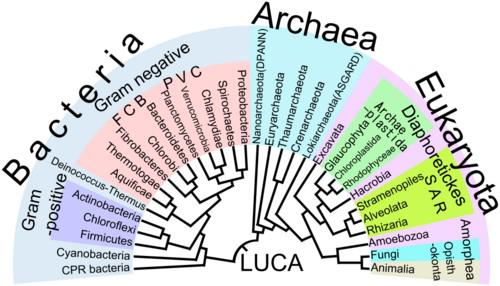
Figure 1 - Phylogenetic tree linking all major groups of living organisms, namely the bacteria, archaea, and eukaryota, with the last universal common ancestor (LUCA) shown at the root.
LUCA occupies a central position in evolutionary biology because it anchors the universal tree of life. Although LUCA itself left no direct fossil record, its existence is strongly supported by molecular evidence. The universality of the genetic code, ribosomal machinery, and core metabolic pathways across all life forms constitutes compelling indirect evidence for a shared ancestor.
Historical and Conceptual Background.
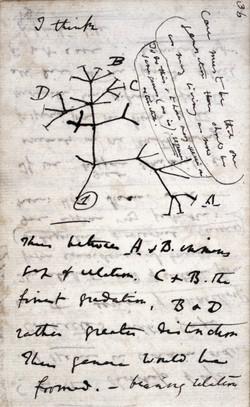
The idea that all living organisms share a common origin dates back to early evolutionary thought. Charles Darwin proposed that life may have descended from “one primordial form,” a hypothesis that was later substantiated by molecular biology. During the twentieth century, advances in biochemistry, genetics, and phylogenetics enabled scientists to compare organisms at the molecular level, revealing deep evolutionary relationships invisible to traditional morphology-based classification.
Figure 2 - A tree of life, like this one from Charles Darwin's notebooks c. July 1837, implies a single common ancestor at its root (labelled "1").
The formal concept of LUCA emerged in the late twentieth century as comparative genomics matured. Analyses of ribosomal RNA sequences and conserved protein families demonstrated that all known cellular life converges on a single ancestral node. This realization transformed LUCA from a philosophical idea into a concrete scientific construct grounded in empirical data.
Approaches to Reconstructing LUCA.
Reconstructing LUCA relies on comparative genomics and phylogenetic inference rather than direct observation. Genes that are conserved across all domains of life are assumed to have been present in LUCA. These include genes encoding ribosomal proteins, transfer RNAs, aminoacyl-tRNA synthetases, and enzymes involved in DNA replication, transcription, and translation.
Phylogenetic reconstruction is complicated by horizontal gene transfer, which was likely widespread in early life. As a result, LUCA is best understood not as a single organism but as a population of genetically related cells exchanging genetic material. Despite these complications, consensus reconstructions indicate that LUCA possessed a substantial and sophisticated genetic repertoire.
Cellular Organization.
LUCA was a fully cellular entity with a defined internal organization. It possessed a lipid-based membrane enclosing an aqueous cytoplasm, separating internal biochemical processes from the external environment. This compartmentalization allowed for controlled metabolic reactions and energy conservation.
The nature of LUCA’s membrane remains a subject of debate. Bacteria and eukaryotes use ester-linked lipids, whereas archaea use ether-linked lipids. LUCA may have possessed a simpler membrane architecture from which these distinct lipid chemistries later evolved. Regardless of its exact composition, the presence of a membrane implies that LUCA was capable of maintaining ionic gradients essential for metabolism.
Genetic Information Processing.
LUCA utilized DNA as its genetic material and employed the universal genetic code to synthesize proteins. The core processes of replication, transcription, and translation were already established. Ribosomes, composed of ribosomal RNA and proteins, translated messenger RNA sequences into functional polypeptides.
Enzymatic systems for DNA repair suggest that LUCA faced significant environmental stress, including radiation and chemical instability. The presence of proofreading and repair mechanisms implies strong selective pressure to maintain genomic integrity even at this early stage of evolution.
Metabolism and Bioenergetics.
LUCA lived in an anaerobic world devoid of free oxygen. Its metabolism relied on chemical energy derived from redox reactions involving simple inorganic molecules. Evidence suggests that LUCA used chemiosmotic coupling, generating energy through ion gradients across membranes.
Metabolic reconstructions point to pathways involving hydrogen, carbon dioxide, nitrogen, and sulfur compounds. Iron-sulfur proteins likely played a central role in catalysis, reflecting the geochemical conditions of early Earth. These metabolic strategies are still observed in some modern anaerobic microorganisms, supporting their ancient origin.
Environmental Context.
LUCA existed on a young Earth characterized by high geothermal activity, intense ultraviolet radiation, and chemically reactive oceans. Oxygen was absent from the atmosphere, and life depended entirely on anaerobic processes. Hydrothermal vent systems are often proposed as plausible habitats for LUCA because they provide continuous energy gradients and mineral catalysts.
However, LUCA may not have been confined to a single environment. Instead, it likely occupied a range of ecological niches, adapting to local conditions through metabolic flexibility. This adaptability would have facilitated the subsequent diversification of life.
Timing and Early Evolution.
Molecular clock analyses estimate that LUCA lived more than 3.5 billion years ago, possibly as early as 4 billion years ago. Shortly after LUCA’s existence, evolutionary divergence led to the separation of bacterial and archaeal lineages. Eukaryotes emerged later through complex evolutionary processes, including endosymbiosis.
The rapid diversification following LUCA suggests that many fundamental biological innovations arose early in Earth’s history. LUCA thus represents a critical transition point between primitive life forms and the ancestors of modern biodiversity.
LUCA and the Tree of Life.
In phylogenetic trees, LUCA occupies the root from which all cellular life branches. This structure supports the hypothesis of universal common descent. Despite extensive diversification, the persistence of conserved molecular features across all life forms underscores their shared ancestry.
The tree of life is not strictly linear; early evolution likely involved extensive genetic exchange. Nevertheless, the concept of LUCA provides a unifying framework for understanding biological diversity.
Viruses and Pre-Cellular Evolution.
The evolutionary relationship between LUCA and viruses remains unresolved. Viruses lack independent metabolism and rely on host cells for replication, making their placement on the tree of life problematic. Some hypotheses propose that viruses evolved after LUCA from cellular genetic elements, while others suggest they may represent remnants of pre-cellular evolutionary systems.
Understanding viral origins has implications for reconstructing early evolution, as viruses may have influenced genetic innovation and horizontal gene transfer.
Scientific and Philosophical Significance.
LUCA is of profound significance not only to biology but also to astrobiology and philosophy of science. It provides a concrete reference point for studying life’s origins and for identifying universal biosignatures that might indicate life elsewhere in the universe.
The inferred complexity of LUCA challenges simplistic models of early life and suggests that biological sophistication emerged rapidly. Continued advances in genomics, computational biology, and experimental biochemistry promise to further refine our understanding of LUCA and the earliest phases of life on Earth.
Conclusion.
The Last Universal Common Ancestor represents the shared biological heritage of all extant life. Although it cannot be observed directly, comparative molecular evidence reveals a complex, metabolically versatile, and fully cellular organism. LUCA stands as a cornerstone of evolutionary theory, linking all living organisms through a common origin and illuminating the deep history of life on Earth.
Summary prepared with the help of ChatGPT from a Wikipedia article: .
https://en.wikipedia.org/wiki/Last_universal_common_ancestor#Age .
MvR – December 23, 2025. ✍️