0% Translated
0% Upvoted
0 Translations, 0 Upvotes, Last Activity None
0 Translations, 0 Upvotes, Last Activity None
0 Translations, 0 Upvotes, Last Activity None
0 Translations, 0 Upvotes, Last Activity None
0 Translations, 0 Upvotes, Last Activity None
0 Translations, 0 Upvotes, Last Activity None
0 Translations, 0 Upvotes, Last Activity None
0 Translations, 0 Upvotes, Last Activity None
0 Translations, 0 Upvotes, Last Activity None
0 Translations, 0 Upvotes, Last Activity None
0 Translations, 0 Upvotes, Last Activity None
0 Translations, 0 Upvotes, Last Activity None
0 Translations, 0 Upvotes, Last Activity None
0 Translations, 0 Upvotes, Last Activity None
0 Translations, 0 Upvotes, Last Activity None
0 Translations, 0 Upvotes, Last Activity None
0 Translations, 0 Upvotes, Last Activity None
0 Translations, 0 Upvotes, Last Activity None
0 Translations, 0 Upvotes, Last Activity None
0 Translations, 0 Upvotes, Last Activity None
0 Translations, 0 Upvotes, Last Activity None
0 Translations, 0 Upvotes, Last Activity None
0 Translations, 0 Upvotes, Last Activity None
0 Translations, 0 Upvotes, Last Activity None
0 Translations, 0 Upvotes, Last Activity None
0 Translations, 0 Upvotes, Last Activity None
0 Translations, 0 Upvotes, Last Activity None
0 Translations, 0 Upvotes, Last Activity None
0 Translations, 0 Upvotes, Last Activity None
0 Translations, 0 Upvotes, Last Activity None
0 Translations, 0 Upvotes, Last Activity None
0 Translations, 0 Upvotes, Last Activity None
0 Translations, 0 Upvotes, Last Activity None
0 Translations, 0 Upvotes, Last Activity None
0 Translations, 0 Upvotes, Last Activity None
0 Translations, 0 Upvotes, Last Activity None
0 Translations, 0 Upvotes, Last Activity None
0 Translations, 0 Upvotes, Last Activity None
0 Translations, 0 Upvotes, Last Activity None
0 Translations, 0 Upvotes, Last Activity None
0 Translations, 0 Upvotes, Last Activity None
0 Translations, 0 Upvotes, Last Activity None
0 Translations, 0 Upvotes, Last Activity None
0 Translations, 0 Upvotes, Last Activity None
0 Translations, 0 Upvotes, Last Activity None
0 Translations, 0 Upvotes, Last Activity None
0 Translations, 0 Upvotes, Last Activity None
0 Translations, 0 Upvotes, Last Activity None
0 Translations, 0 Upvotes, Last Activity None
0 Translations, 0 Upvotes, Last Activity None
0 Translations, 0 Upvotes, Last Activity None
0 Translations, 0 Upvotes, Last Activity None
0 Translations, 0 Upvotes, Last Activity None
0 Translations, 0 Upvotes, Last Activity None
0 Translations, 0 Upvotes, Last Activity None
0 Translations, 0 Upvotes, Last Activity None
0 Translations, 0 Upvotes, Last Activity None
0 Translations, 0 Upvotes, Last Activity None
0 Translations, 0 Upvotes, Last Activity None
0 Translations, 0 Upvotes, Last Activity None
0 Translations, 0 Upvotes, Last Activity None
0 Translations, 0 Upvotes, Last Activity None
0 Translations, 0 Upvotes, Last Activity None
0 Translations, 0 Upvotes, Last Activity None
0 Translations, 0 Upvotes, Last Activity None
0 Translations, 0 Upvotes, Last Activity None
0 Translations, 0 Upvotes, Last Activity None
Summary of Paul Birch (1991): "Terraforming Venus Quickly".
Reference: Birch, P. (1991). Terraforming Venus Quickly. Journal of the British Interplanetary Society, 44, 157–167.
Introduction.
Paul Birch's 1991 paper Terraforming Venus Quickly is one of the most ambitious studies ever written on planetary engineering.
Rather than asking whether humans could someday live on Venus, Birch asks a much bolder question: Could an advanced technological civilization transform Venus into a second Earth within a few centuries?
Although many of the technologies he discusses remain far beyond our present capabilities, Birch approaches the subject as an engineering exercise governed by known physical laws rather than as science fiction. His paper remains influential because it presents a coherent sequence of steps that, in principle, could convert our nearest planetary neighbor into a habitable world.
The paper begins from an important observation. Venus is remarkably similar to Earth in size, mass, and surface gravity. A person standing on a terraformed Venus would weigh only about ten percent less than on Earth. If the atmosphere and climate could somehow be transformed, Venus would arguably be a more Earth-like home than Mars.
The problem, of course, is that today's Venus is one of the most hostile environments in the Solar System.
Its surface temperature averages about 465°C, hot enough to melt lead. The atmospheric pressure is approximately ninety-two times that of Earth, equivalent to the pressure experienced nearly one kilometer beneath Earth's oceans. The atmosphere consists almost entirely of carbon dioxide, and thick sulfuric-acid clouds permanently conceal the surface.
Birch argues that these conditions, extreme as they are, all originate from a single underlying cause: the enormous carbon dioxide atmosphere. Remove or neutralize that atmosphere, and nearly every other problem becomes manageable.
Step One: Cooling Venus.
Birch considers cooling the planet the essential first step.
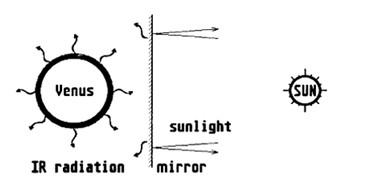
Instead of attempting to cool the atmosphere directly, he proposes reducing the amount of sunlight reaching Venus by placing an immense sunshade near the Sun–Venus L1 Lagrange point, where the gravitational attraction of the Sun and Venus balance in such a way that a spacecraft can remain approximately fixed between them.
Figure – Sunshade mirror to cool Venus.
The proposed shade would be thousands of kilometers across and would block much of the incoming solar radiation. Once sunlight was reduced, Venus would begin cooling naturally.
The cooling process would take many decades, but as temperatures fell, the atmosphere would undergo dramatic changes. Carbon dioxide, which exists today as a dense supercritical fluid near the surface, would first liquefy and eventually freeze into solid dry ice.
This phase change is central to Birch's proposal because it allows most of the atmosphere to be removed from circulation without requiring enormous amounts of energy to launch it into space.
Step Two: Stabilizing the Frozen Atmosphere.
Simply freezing the carbon dioxide is not enough.
If sunlight later returned, the dry ice would eventually sublime back into gas, recreating the original greenhouse atmosphere.
Birch therefore proposes covering the frozen carbon dioxide with insulating material. The insulating layer would prevent solar heating from reaching the dry ice, allowing it to remain permanently frozen beneath the surface.
This solution differs from proposals that attempt to remove the carbon chemically. Birch regards long-term storage as a far more practical engineering solution than processing hundreds of trillions of tons of atmospheric carbon.
Although later researchers questioned whether this storage would remain stable over geological time, Birch argues that it would remain sufficiently secure for the foreseeable future of a human civilization.
Step Three: Supplying Water.
Even after cooling, Venus would remain almost completely dry.
To create oceans and support life, vast quantities of water would have to be imported from elsewhere in the Solar System.
Birch considers several possible sources, eventually favoring large icy bodies from the outer Solar System. He discusses the possibility of redirecting one or more icy moons or extremely large comet-like objects toward Venus under carefully controlled conditions.
The imported ice would melt after impact or controlled delivery, producing oceans and providing hydrogen needed for atmospheric chemistry and biological processes.
The scale is astonishing. Earth possesses about 1.4 billion cubic kilometers of ocean water, and while Birch does not insist that Venus duplicate Earth's oceans exactly, he envisions importing enough water to establish a global hydrological cycle with clouds, rainfall, rivers, lakes, and seas.
Step Four: Creating a Breathable Atmosphere.
Once Venus had cooled and acquired water, the remaining atmosphere would still be unsuitable for humans.
Birch proposes constructing a new atmosphere broadly similar to Earth's, composed primarily of nitrogen with oxygen produced over time by photosynthetic organisms.
Fortunately, Venus already contains a significant amount of nitrogen—roughly three and a half times as much as Earth's atmosphere in total mass because of its enormous atmospheric pressure. Once the excess carbon dioxide had been removed, this nitrogen could serve as the foundation of the new atmosphere.
Oxygen would initially be absent. Birch expects microorganisms, algae, and eventually plants to generate oxygen through photosynthesis, gradually creating a breathable atmosphere over many generations.
Step Five: Controlling Day and Night.
One of Venus's unusual characteristics is its extraordinarily slow rotation.
A single Venusian day lasts 243 Earth days, longer than its year. Such a day-night cycle would create enormous temperature differences and present challenges for both ecosystems and human settlements.
Rather than attempting to accelerate the planet's rotation—a project requiring truly extraordinary amounts of energy—Birch proposes an elegant alternative.
Large orbiting mirrors, sometimes called "solettas," would reflect sunlight onto selected regions of the planet, creating an artificial 24-hour illumination cycle independent of the planet's actual rotation.
These mirrors would not simply illuminate the surface. They could also regulate climate, lengthen growing seasons, warm polar regions, and provide highly controlled environmental conditions for agriculture.
Human Settlement During Terraforming.
Unlike many terraforming proposals that assume humanity must wait until the process is complete, Birch argues that settlement could begin almost immediately.
At altitudes around fifty kilometers above Venus's surface, atmospheric pressure and temperature are surprisingly close to those found on Earth.
Floating cities suspended in the atmosphere could therefore become the first permanent human settlements on Venus.
These aerial habitats would serve several purposes. They would house scientists and engineers, manufacture components for the terraforming project, and gradually expand into an industrial infrastructure capable of constructing mirrors, sunshades, and orbital facilities.
In Birch's vision, atmospheric colonization and planetary terraforming proceed simultaneously rather than sequentially.
Space Industry on a Solar-System Scale.
One of the paper's most striking features is its implicit assumption that civilization has already developed a mature space economy.
Virtually every step depends upon extensive industrial activity throughout the Solar System.
Mining operations would extract raw materials from asteroids and planets. Orbital factories would manufacture enormous structures. Nuclear or solar power would provide essentially unlimited energy. Highly automated transportation systems would move billions of tons of material between planets.
Birch never suggests that twentieth-century technology could accomplish these tasks. Instead, he assumes a civilization whose industrial capabilities in space are comparable to humanity's present industrial capabilities on Earth.
Seen in this light, the paper is less about inventing new physics than about applying known physics on an unprecedented scale.
Timescale.
The word "quickly" in the paper's title is intentionally provocative.
Birch estimates that, given the assumed technological capabilities, major phases of the project could be completed within roughly two centuries.
Many later researchers consider this optimistic. Modern analyses generally suggest that cooling the planet alone might require several centuries, while ecological stabilization could take much longer.
Nevertheless, Birch's estimate reflects his assumption that the limiting factor is industrial capacity rather than scientific understanding.
Scientific Legacy.
Although some aspects of Birch's proposal have been challenged—particularly the long-term stability of buried carbon dioxide and the enormous logistical demands of importing water—his paper established the basic engineering framework that still underlies discussions of Venus terraforming.
Later researchers, including Steve Gillett, shifted attention toward long-term climate stability and planetary geochemistry. Others, such as Geoffrey Landis, concluded that living permanently in Venus's upper atmosphere might be far more practical than transforming the entire planet.
Yet Birch's work remains remarkable for its coherence. Every stage of the project follows logically from the previous one, and each engineering problem is addressed within a consistent physical framework.
Perhaps the paper's most enduring contribution is its perspective. Birch encourages readers to think not in terms of individual spacecraft or isolated missions, but in terms of civilizations capable of reshaping entire worlds. Whether or not humanity ever attempts such a project, Terraforming Venus Quickly remains one of the clearest demonstrations of how planetary science, engineering, astronomy, and long-term thinking can be combined into a single grand vision.
Today, more than three decades after its publication, Birch's paper is still regarded as the foundational work on Venus terraforming. While modern researchers often favor more modest goals—such as floating cities in Venus's temperate cloud layer rather than complete planetary transformation—they continue to engage with Birch's ideas because he framed the central engineering questions with exceptional clarity. His work occupies a unique place in the history of planetary engineering: not as a blueprint ready for construction, but as a carefully reasoned exploration of what might become possible for a technologically mature civilization.
Article prepared by ChatGPT at MvR's request, July 10, 2026. ✍️